Why I Started Using a Bowl to Catch Everything I Drop at Night
I didn’t start using a bowl by my bed because I wanted to organize my life or create a better nighttime routine. I definitely didn’t think of it as a “hack” at first, but because I was tired of the small, specific stress that kept repeating itself every evening and every morning without fail. It…
I didn’t start using a bowl by my bed because I wanted to organize my life or create a better nighttime routine. I definitely didn’t think of it as a “hack” at first, but because I was tired of the small, specific stress that kept repeating itself every evening and every morning without fail.
It was the stress of dropping things when I was already tired, watching them disappear into shadow, and then feeling an unnecessary spike of irritation at the very end of the day when I had no energy left to spare.
It always happened in the same way, with my phone slipping off the bed, my rings rolling just far enough to vanish, my lip balm bouncing once and then becoming impossible to find, or my glasses landing somewhere I would absolutely forget about by morning.
None of it was dramatic, but the accumulation of those moments made going to bed feel slightly chaotic, like the day refused to end cleanly.
The Night I Finally Got Tired of Losing Things
The night that pushed me over the edge wasn’t worse than the others, but it was more absurd, because I dropped my phone, my lip balm, and one earring within the span of about thirty seconds, all while standing in the same spot beside my bed.
I remember standing there, blinking in the low light, feeling that specific blend of tiredness and annoyance that makes everything feel harder than it needs to be.
I didn’t want to turn on the overhead light, and I didn’t want to crawl around on the floor, and I definitely didn’t want to start the next morning already frustrated.
That’s when I grabbed a ceramic bowl from the kitchen, one that wasn’t doing much besides holding fruit, and placed it on my bedside table without thinking too hard about it.
I didn’t realize then that I was about to solve a problem that had been quietly bothering me for years.
The Bowl Isn’t Decorative, and That’s the Point
The bowl I use isn’t special, and that’s part of why this works so well, because it doesn’t ask to be curated or admired. It’s wide, heavy enough not to tip easily, and deep enough that things fall into it rather than bounce out, which matters more than how it looks.
I placed it exactly where my hand naturally hovers at night, not centered or styled, but slightly off to the side where gravity tends to take over when I’m tired. The location is the entire trick, because the bowl works with my habits instead of trying to correct them.
If something slips from my hand, it lands in the bowl. If I take something off, it goes into the bowl. If I don’t know what to do with something, it goes into the bowl. No decisions required.
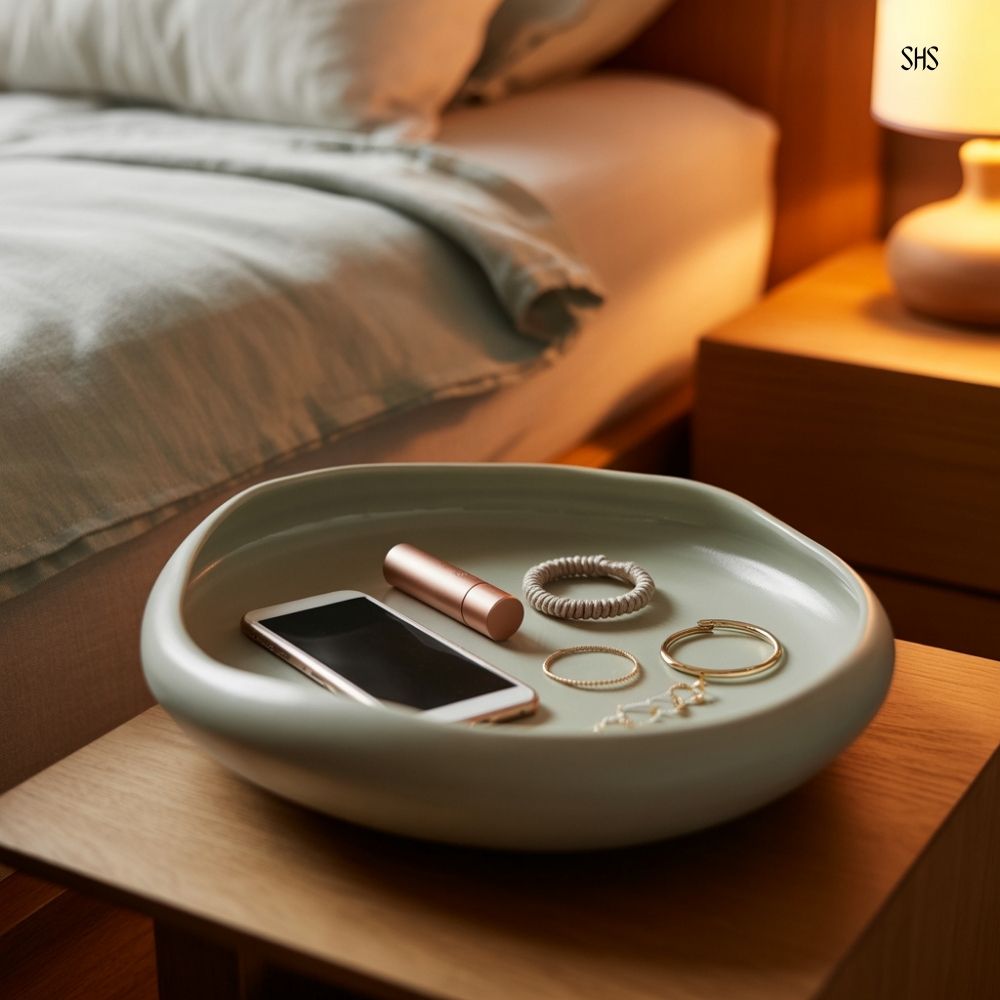
What Goes Into the Bowl Every Night
Over time, the bowl became a catch-all in the most literal sense, holding everything that used to scatter across the floor or disappear into corners when my brain was already half asleep.
My phone lands there instead of sliding off the bed, my rings drop into it with a soft clink instead of rolling away, my lip balm ends up contained rather than lost, and my glasses rest safely without the risk of being stepped on in the morning.
Sometimes a hair tie or earring joins the collection, and occasionally a receipt or a folded note I didn’t want to deal with yet, but the bowl doesn’t judge what goes into it, and that lack of judgment is exactly why it works.
Why This Reduced More Stress Than I Expected
What surprised me wasn’t just that I stopped losing things at night, but how much calmer my mornings became as a result. Waking up and knowing exactly where my essentials were removed a small but constant source of stress I hadn’t realized was shaping the start of my day.
There’s something deeply reassuring about not having to search the floor first thing in the morning, about reaching for your glasses and finding them immediately, about knowing your rings didn’t wander off overnight.
That sense of order carries forward quietly, making the morning feel less reactive and more grounded.
The Psychology Behind Why This Works
I realized after a while that the bowl works because it removes the need for precision at a time when precision is unrealistic. At night, my coordination is worse, my attention is scattered, and my patience is thin, and asking myself to place things carefully is simply too much.
The bowl creates a wide margin for error, catching things even when I miss, and that generosity is what makes it effective. Instead of correcting my behavior, it adapts to it, which feels like a small act of self-kindness rather than discipline.
Before the bowl, bedtime felt like a series of tiny annoyances stacked together, each one small enough to ignore on its own but collectively draining. After the bowl, bedtime became smoother, quieter, and less interrupted, because nothing was being lost or fumbled at the very end.
That smoothness made it easier to relax, because my nervous system wasn’t bracing for one more thing to go wrong.
Why I Don’t Empty the Bowl Right Away
One of the reasons this habit stays gentle rather than rigid is that I don’t empty the bowl every morning, and I don’t force myself to sort it immediately. Sometimes I do, and sometimes I don’t, and both are fine.
The bowl isn’t meant to be perfect storage, but temporary safety, a holding space for things that don’t need to be dealt with right now. Treating it that way keeps it from turning into another chore.
This small habit taught me that reducing stress doesn’t always require changing yourself, but changing the environment around you so it supports you better. Instead of asking myself to be more careful at night, I gave myself a wider landing zone.
That shift made everything feel easier. It reminded me that the most effective solutions are often the least demanding ones.
Today’s Charm
Put a wide, sturdy bowl beside your bed tonight and let it catch whatever your tired hands drop without complaint.
What’s one small place where your space could be kinder to you instead of asking you to try harder?